
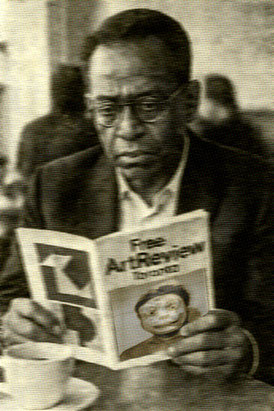
Leo Marsalla, Free ArtReview Toronto
Leo Marsalla, (born 1960 in Toronto, Canada) is a
Canadian art journalist, essayist, and cultural critic. He became known for his contributions to Toronto's alternative art scene since the late 1980s as well as for his work for the underground
magazine Free ArtReview Toronto.
Life: Leo Marsalla was born in Toronto
in 1960. He is the son of a black Jewish father and a mother with roots in a Canadian Indigenous community. This diverse cultural background shaped his later interest in questions of identity,
representation, and cultural hybridity in art. Marsalla studied art history and philosophy at the University of Toronto, where he focused in particular on aesthetics, poststructuralism, and the
role of art in urban space. After graduating, he initially worked as a freelance writer and curator for smaller galleries in the Toronto area. Work and Activity: Since the
mid-1980s, Marsalla has been writing regularly for the alternative magazine Free ArtReview Toronto, which is dedicated to the city's independent art and cultural scene. His essays and reviews are
characterized by a combination of social analysis and poetic language. Marsalla is considered a voice of urban counterculture and frequently addresses power structures in the art world, cultural
appropriation, and the role of minorities in contemporary art production. In addition to his journalistic work, Marsalla has published several collections of essays and has given lectures at art
academies and universities in Canada and the United States. Style and Themes: Marsalla's writing style combines academic reflection with narrative intensity. His recurring themes include: • the
relationship between art and social justice, • identity politics in art, • the connection between philosophy and visual culture, and the history of urban subcultures. Private life: Marsalla lives and works in Toronto,
where he continues to work as a freelance writer. In interviews, he frequently emphasizes the importance of cultural diversity and the need to make marginalized perspectives more visible in art
criticism.
Leo Marsalla, (geboren 1960 in Toronto, Kanada) ist ein kanadischer Kunstjournalist, Essayist und Kulturkritiker. Bekannt wurde er durch seine Beiträge zur alternativen Kunstszene Torontos seit den späten 1980er Jahren sowie durch seine Arbeit für die Undergroundzeitschrift Free ArtReview Toronto.
Leben: Leo Marsalla wurde 1960 in Toronto geboren. Er ist der Sohn eines schwarzen jüdischen Vaters und einer Mutter mit Wurzeln in einer kanadischen indigenen Gemeinschaft. Diese vielfältige kulturelle Herkunft prägte sein späteres Interesse an Fragen der Identität, Repräsentation und kulturellen Hybridität in der Kunst. Marsalla studierte Kunstgeschichte und Philosophie an der University of Toronto, wo er sich insbesondere mit Ästhetik, Poststrukturalismus und der Rolle der Kunst im urbanen Raum beschäftigte. Nach seinem Abschluss arbeitete er zunächst als freier Autor und Kurator für kleinere Galerien im Raum Toronto.
Werk und Wirken: Seit Mitte der 1980er Jahre schreibt Marsalla regelmäßig für die alternative Zeitschrift Free ArtReview Toronto, die sich der unabhängigen Kunst- und Kulturszene der Stadt widmet. Seine Essays und Rezensionen zeichnen sich durch eine Verbindung von gesellschaftlicher Analyse und poetischer Sprache aus. Marsalla gilt als Stimme der urbanen Gegenkultur und thematisiert häufig Machtstrukturen im Kunstbetrieb, kulturelle Aneignung sowie die Rolle von Minderheiten in der zeitgenössischen Kunstproduktion. Neben seiner journalistischen Tätigkeit veröffentlichte Marsalla mehrere Essaysammlungen und hielt Vorträge an Kunsthochschulen und Universitäten in Kanada und den Vereinigten Staaten.
Stil und Themen: Marsallas Schreibstil kombiniert akademische Reflexion mit erzählerischer Intensität. Zu seinen wiederkehrenden Themen zählen: • das Verhältnis von Kunst und sozialer Gerechtigkeit, • Identitätspolitik in der Kunst, • die Verbindung von Philosophie und visueller Kultur, • und die Geschichte der urbanen Subkulturen.
Privatleben:Marsalla lebt und arbeitet in Toronto, wo er weiterhin als freier Autor tätig ist. In Interviews betont er häufig die Bedeutung kultureller Diversität und die Notwendigkeit, marginalisierte Perspektiven in der Kunstkritik sichtbarer zu machen.
Leo Marsalla about Kai Matussik and "Whatever"
Prolegomena to the Ontology of Origin: The “Whatever” Cycle
In contemporary art production, we rarely encounter such a direct engagement with the paradox of *form-taking*—the emergence of form—as is expressed in the “Whatever” series. Here, the artist devotes himself to a subject that, due to its microscopic scale, eludes direct empirical observation: the human sperm and the egg cell.
The Manifestation of the Invisible
The artistic project is constituted primarily by the attempt to endow the seemingly amorphous with a distinct visibility. What exists in nature merely as a carrier of information within the sub-visible realm undergoes a sculptural transfiguration here. The works “Happy Seed” and “Felix Ovum” serve as semiotic anchor points within this context. Executed in clay—a material regarded since antiquity as the epitome of creation symbolism—these objects oscillate between the didactic model and the sacred monument.
Particularly noteworthy is the curatorial decision regarding formal equalization: by leveling the natural size disparity between the sperm and the ovum, a visual symmetry is established. This aesthetic intervention emancipates the protagonists of procreation from their biological functionality, elevating them to the status of iconic representatives of the will to live.
From Microcosm to Kinetic Narrative
The accompanying photographic works expand the static concept of the artwork by introducing a dynamic dimension. They visualize that “Journey of the 300 Million”—an event conceived as an act that is simultaneously competitive and creative. Here, photography serves as a medium to depict the spectrum of human existence in all its ambivalence. The artist aptly describes this process as a “dance”—a metaphor encompassing both the cruelty of selection and the vibrancy of individual unfolding. Love as Aesthetic Finality
In conclusion, "Whatever" does not leave the viewer adrift in the realm of arbitrariness that its title might initially seem to provoke. Rather, it culminates in a teleological intensification. The inquiry into the meaning of the *theatrum mundi*—the world-theater of emergence—finds its answer in an almost radical affirmation of the affective. Here, love is declared not merely as a sentiment, but as the fundamental force that generates identity and meaning out of the chaos of matter.
Thus, "Whatever" constitutes a profound meditation on genesis: a work that monumentalizes the smallest elements in order to render the greatest comprehensible.